Brand Identity vs. Brand Design vs. Brand Strategy: The Differences Founders Always Miss
Most founders ask for "a brand" and get a logo. Here is what 'brand strategy', 'brand identity', and 'brand design' actually mean and why confusing them is the most expensive mistake in a rebrand.
In briefBrand strategy is the plan — your positioning, audience, and message. Brand design is the visual execution of that plan. Brand identity is the complete system of visuals and voice that makes you recognisable. Most founders confuse them because designers often blur the lines.
Brand Identity vs. Brand Design vs. Brand Strategy: The Differences Founders Always Miss
A founder emails a designer and asks for "a brand".
The designer sends back a logo, a colour palette, and a type system. The founder looks at it, feels like something is missing, and cannot explain what. So they ask for more slides. The designer adds a brand guidelines PDF. The founder still feels like something is missing.
Three months later, the company is running ads that do not sound like the website, hiring salespeople who pitch the product differently from how marketing talks about it, and wondering why nothing feels coherent.
This is what happens when "brand" is treated as a single thing when it is actually three different disciplines that work together. Confusing them is not a small mistake. It is the kind of confusion that produces mis-scoped briefs, mismatched vendor relationships, and brand investment that does not compound.
Here is how to tell them apart.
The Three Things People Mean When They Say "Brand"
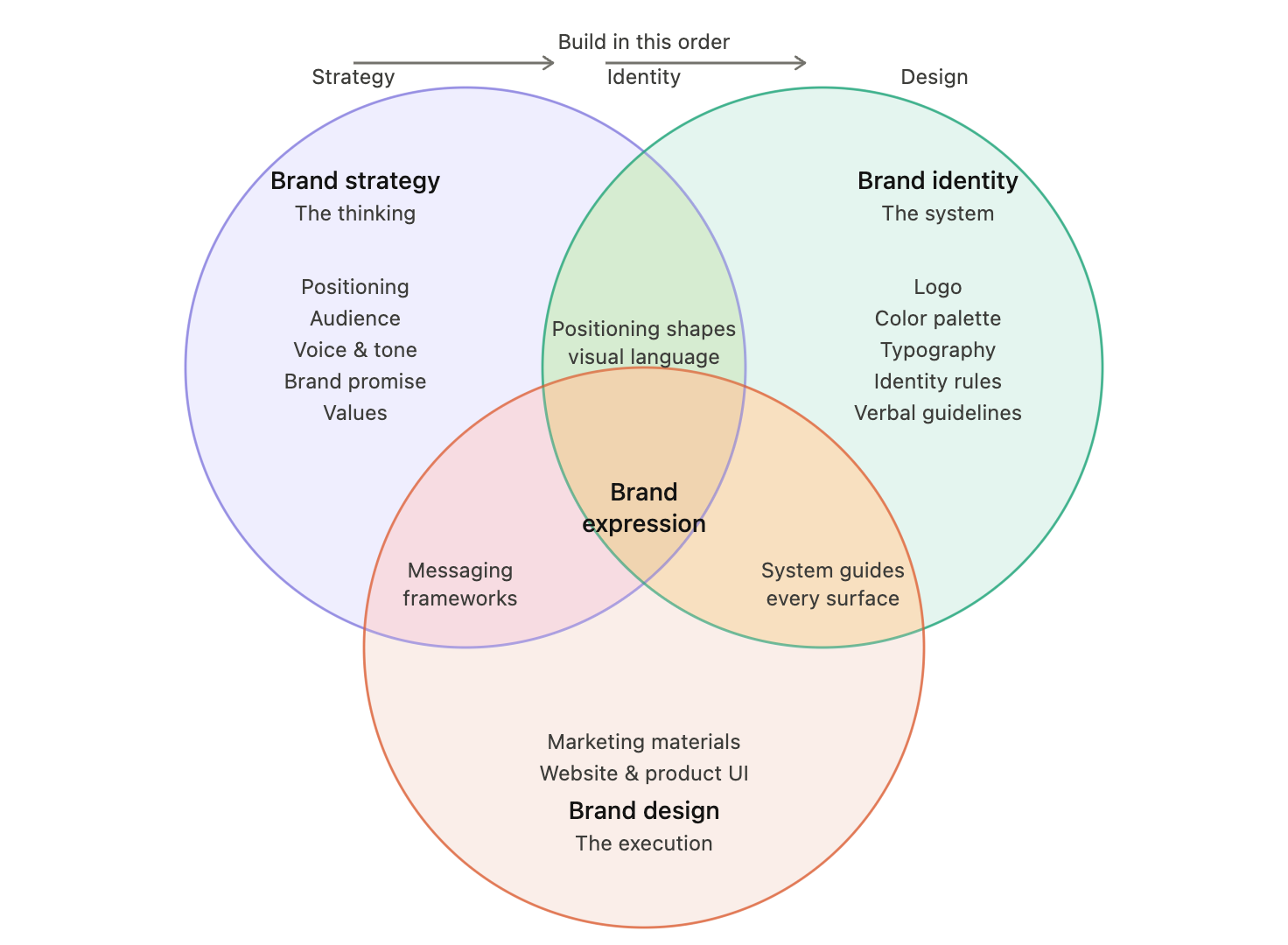
When a founder says they need "brand work done", they usually mean one of three things, and sometimes all three, without knowing it. The three disciplines are brand strategy, brand identity, and brand design. They are related. They are not the same. Each one answers a different question, requires different skills, and produces different outputs.
Brand Strategy: The Thinking Before the Making
Brand strategy answers the question: who are you, for whom, and why does it matter? It is not a deliverable you can hold. It is a set of decisions that inform everything else. Brand strategy covers:
Positioning. Where does this brand sit in the market relative to competitors? What territory does it own? A payments company that is "fast" is not positioned. A payments company that is "the one built for logistics operators who lose money on reconciliation errors" is positioned.
Audience definition. Not demographics. Psychographics, motivations, and the specific job your brand is doing in their life or business.
Brand voice and tone. How does the brand speak? What does it never say? This is a strategy, not copywriting. The copywriter works from this.
Promise and proof. What is the brand committing to deliver? What evidence supports that commitment?
Values. Not the wall-art kind. The kind that actually informs hiring decisions, product decisions, and what you turn down.
Brand strategy is the document a good designer reads before touching a single pixel. When founders skip it, they end up briefing designers on aesthetics instead of meaning, and the result is a beautiful brand that does not say anything. The output of brand strategy is usually a strategy deck or brand platform document. No logos. No colours. Just thinking.
Brand Identity: Where Strategy Becomes a System
Brand identity answers the question: what does this brand look, sound, and feel like consistently? This is where most people think "brand" starts. It actually starts much later in the process, after strategy. Brand identity takes the strategic decisions and translates them into a repeatable system. It covers:
Visual identity. Logo, colour palette, typography, iconography, photography direction, and illustration style. The elements that make the brand visually recognisable.
Verbal identity. Tone of voice guidelines, messaging hierarchy, tagline, and boilerplate copy. How the brand speaks in practice.
Identity standards. The rules for how all of the above get applied. What the logo looks like on a dark background. Which typeface is for headlines versus body copy? What is always off-limits?
Brand identity is a system, not an artefact. A logo is an artefact. Brand identity is the logic that governs how every expression of the brand is made. This is what brand identity services actually deliver: a coherent, documented system that a team can use to produce consistent brand expression across every surface, without the designer being in the room for every decision. When founders receive a logo and call it "brand identity", they have received one artefact from a system that was never built. That is usually why things fall apart in execution.
Brand Design: Identity Applied to Surfaces
Brand design answers the question: how does the brand show up in specific contexts? If brand identity is the system, brand design is the system in use. Brand design is the work of applying the identity to real surfaces and real problems. It covers:
Marketing materials. Pitch decks, one-pagers, social media templates, ad creative, and email headers.
Digital surfaces. Website design, app UI, landing pages. The product's visual layer.
Physical touchpoints. Packaging, signage, merchandise, and event materials.
Campaigns. Specific creative executions are built around the brand identity for a particular moment or goal.
Brand design is the most visible layer. It is also the most dependent on the layers beneath it. Good brand design executed on top of a weak identity system produces inconsistency. Inconsistency erodes recognition. Eroded recognition increases acquisition cost. The reason most startup brands look scattered is not a design talent problem. It is a system problem. Individual pieces of brand design are being made without a shared identity to pull from.
How They Relate
Strategy sits at the foundation. It informs identity. Identity enables design. Each layer requires the one beneath it to function properly. You can have a beautiful brand design with no brand identity system; it just will not scale. You can have a brand identity with no strategy; it just will not mean anything. And you can have a strategy document that never gets translated into identity or design, in which case it sits in a Google Drive folder and does nothing. The goal is all three, built in the right order.
Where Founders Get Confused (And Why It Is Expensive)
Confusion 1: Hiring a designer when you need a strategist. If you cannot clearly articulate who your brand is for and what it stands for, hiring someone to make it look good is premature. You will brief them on vibes and receive vibes back.
Confusion 2: Calling a logo a brand identity. A logo is one element of a visual identity. A visual identity is one component of brand identity. Brand identity is one layer of the full brand. Knowing this prevents you from thinking the work is done when it has barely started.
Confusion 3: Treating brand design as one-off work. Brand design is ongoing. The identity system is the infrastructure. The design work is the output that the infrastructure enables, and it never stops.
Confusion 4: Skipping strategy because it does not feel tangible. Strategy feels expensive and abstract until you see what happens when you skip it. Inconsistent messaging, positioning that shifts with every new hire, a sales team and a marketing team describing the same product in completely different terms. That is what strategy was supposed to prevent.
What to Ask For When You Are Scoping Brand Work
If you are briefing an agency or freelancer on brand work, here are the questions that will sharpen the scope fast: Are we starting from scratch, or does a strategy already exist? If no strategy exists, the first deliverable should be a brand platform, not a logo. Do we have an identity system or just artefacts? If you have a logo and colours but no documented system, you need identity work before more design work.
What surfaces are we designing for right now? This tells you how much brand design you need in the first engagement versus what can come later. Who will be executing brand design after this engagement ends? If it is an internal team, they need a system they can actually use. That changes what "identity" deliverables need to look like.
Good brand identity services will walk you through these questions before quoting anything. If someone jumps straight to deliverables without understanding your strategic foundation, that is worth slowing down for.
Brand strategy is the thinking. Brand identity is the system. Brand design is the system in action. All three matter. Order matters. Skipping steps is always cheaper in the short term and always more expensive over time.
If you are a founder scoping brand work for the first time or trying to figure out why your existing brand is not working the way you expected, start by identifying which layer is actually missing. That will tell you exactly what to go fix.
Let's create something remarkable together.